
💡 Rethinking the “Greedy VC” Narrative Around >1x Liquidation Preferences
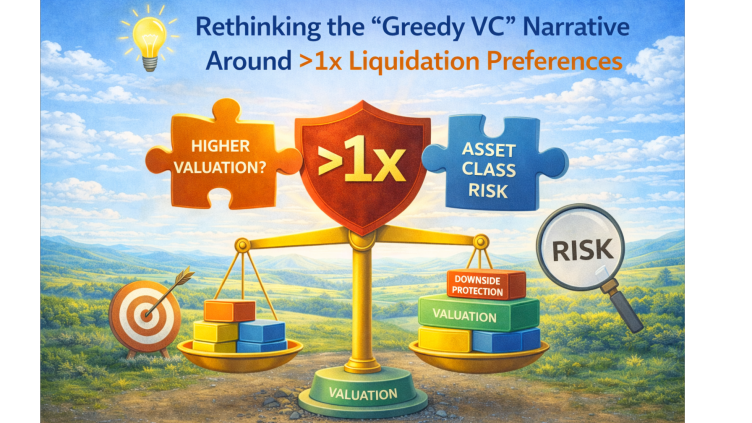
In startup land, few terms trigger founders more than “multiple liquidation preference.” The moment a VC asks for anything above 1x, the reflexive reaction is often: “They’re being greedy.”
But like most things in venture, the reality is more nuanced — and, frankly, more interesting.
I want to offer a different lens. Not to defend every term sheet ever written, but to broaden the conversation. Because sometimes a >1x preference isn’t greed at all. It’s information.
🧩 1. A Higher Preference Can Be a Substitute for Higher Valuation
Founders love high valuations. VCs love high expected value (EV). Those two things don’t always align.
If a VC feels the valuation is pushing the upper boundary of what they believe the company is worth today, they have two choices:
• Say no to the deal
• Or compensate for the higher valuation by adjusting structure
A >1x preference is one of the cleanest ways to do that.
It’s not “punishment.” It’s a way to balance risk and return when the valuation feels stretched. Think of it as: “If we’re taking more risk on the EV, we need a mechanism to balance that risk.”
In other words, structure becomes the counterweight to price.
🎯 2. Venture Capital Requires Asymmetric Upside
VCs don’t invest for 2x outcomes. They invest for 20x outcomes — because only a tiny fraction of companies ever get there.
When a VC asks for a >1x preference, it can signal something important:
They’re not fully convinced the upside is as large or as likely as the founders believe.
That’s not an insult. It’s the nature of the asset class.
If the VC believed the company was a rocket ship with a massive, credible exit path, they wouldn’t bother with a 1.5x or 2x preference. They’d want as much common as possible. They’d want exposure to the upside, not protection on the downside.
So a >1x preference is often a message: “We’re not sure the exit will reach the heights management expects, so we need a return even in the midrange outcomes.”
📉 3. Preferences Are About Breakpoints, Not Control
Preferences only matter at specific exit breakpoints.
If the company exits above a certain threshold, preferences disappear into the background — everyone converts, everyone participates, everyone wins.
But if the exit lands below that threshold, the preference determines whether the VC earns a meaningful return.
So when a VC asks for >1x, they’re effectively saying:
“If the exit is only moderate, we need to ensure the economics still make sense for us.”
This isn’t greed. It’s clarity about risk.
🚀 4. At Very Large Exits, Preferences Don’t Matter Anyway
Here’s the irony: Founders who obsess most over liquidation preferences are often the ones who claim to believe in massive outcomes.
But if you truly believe your company will exit at a level where everyone converts to common, then:
Preferences are irrelevant.
A 1x, 1.5x, or even 2x preference disappears in a big win. Everyone participates prorata. Everyone celebrates.
So sometimes, a founder’s fixation on preferences signals something deeper:
• A lack of confidence in achieving a large exit
• Or a mismatch between the founder’s stated ambition and their internal expectations
If you’re building for a $1B+ outcome, a 1.5x preference shouldn’t keep you up at night.
🧭 The Real Question Founders Should Ask
Instead of reacting emotionally to structure, ask:
“What is this preference telling me about how the investor perceives risk, valuation, and upside?”
Because preferences aren’t just terms. They’re signals.
Signals about belief. Signals about alignment. Signals about how each party views the journey ahead.
🔚 Final Thought
Not all preferences are good. Not all preferences are fair. And yes, sometimes they are used aggressively.
But dismissing every >1x preference as “greedy” misses the point.
Sometimes it’s simply the VC saying:
• “We’re stretching on valuation.”
• “We’re uncertain about the upside.”
• “We need downside protection to make the economics work.”
And sometimes, it’s a subtle test of the founder’s own conviction.
Because if you truly believe you’re going to live the dream — the kind of exit where everyone converts and everyone wins — then the preference is just noise.


Comments