
The Institutionalization of Venture Capital Fair Value
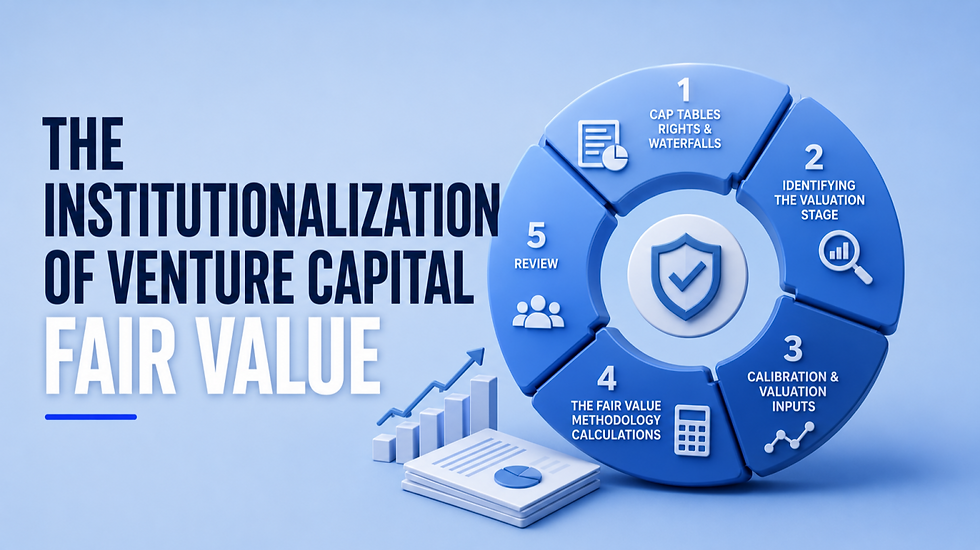

As venture capital has matured into a true institutional asset class, expectations around fair value have evolved significantly.
Fair value is no longer just a quarter end exercise, or the mechanical application of a valuation model. It is becoming an institutionalized process: repeatable, transparent, evidencebased, and capable of being clearly articulated to investment committees, auditors, LPs, and regulators.
This shift is also reflected in industry guidance. Frameworks such as IPEV and AICPA have moved well beyond theoretical discussions of valuation methodologies. The focus today is increasingly on process - on calibration, methodology selection, documentation, and governance.
It is not just about what methodology you use, but how you arrive at and support your fair value conclusion.
Importantly, institutionalization does not eliminate professional judgment. It simply ensures that judgment is applied within a structured, consistent framework.
At VCM, we increasingly think about fair value as a process made up of five connected stages:
1. Cap Tables - Rights & Waterfalls
Fair value starts with understanding ownership economics.
Who owns what is only part of the story.
Liquidation preferences, participation rights, conversion mechanics, breakpoints, and waterfall allocations all shape how value flows through the capital structure.
Without this foundation, fair value conclusions are difficult to defend.
The objective here is not just modeling ownership -it is building a framework that is transparent, auditable, and repeatable.
We are also seeing a shift away from fragmented spreadsheets toward purposebuilt platforms that institutionalize this layer.
2. Identifying the Valuation Stage
Not every company should be valued the same way.
Valuation approach should reflect the company’s current stage and circumstances:
• A recent financing round
• A long period without capital activity
• A strategic pivot
• A path toward liquidity
• A transition from early to later stage
Methodology selection should follow facts - not habits.
Examples include:
• Transaction Price following a recent round
• OPM / Backsolve OPM where a financing round sets the starting point
• Enterprise Value approaches (including PWERM) for more mature companies
• Current Value Method (CVM) as liquidity becomes imminent
3. Calibration & Valuation Inputs
Calibration is where discipline is enforced.
Market evidence matters:
• Financing rounds
• Milestone progress (or misses)
• Burn and runway
• Investor behavior
• Macro and micro conditions
The key questions become:
What would a sophisticated market participant pay today, given current facts? How has fair value evolved since the last reporting period?
Calibration keeps valuation anchored to reality rather than drifting into abstract modeling.
Equally important: inputs must be supportable and documented.
Examples:
• OPM: volatility, time to liquidity, riskfree rate, breakpoints
• PWERM: scenarios, probabilities, timing, and exit assumptions
4. The Fair Value Methodology Calculations
Calculations make fair value measurable - but they should never be the starting point.
A robust calculation is built on:
• Accurate cap tables
• Well understood rights and waterfalls
• Clear stage identification
• Proper calibration
• Defensible assumptions
Only then should methodologies be applied: OPM, Backsolve, Enterprise Value, PWERM, Waterfalls, CVM.
Today, these calculations no longer need to live in isolated spreadsheets. Integrated platforms are emerging that unify data, logic, and outputs into a consistent workflow.
Because ultimately, the calculation is not the destination- it is the output of a well designed process.
5. Review
A sound fair value process extends beyond the model.
It requires:
• Clear documentation
• Committee oversight
• Portfolio consistency
• Historical tracking
• Governance and transparency
At first glance, institutionalization may seem complex.
In practice, once the process is defined and supported by the right infrastructure, it leads to something much simpler:
Consistency. Transparency. Repeatability.
Fair value is rarely a single number produced by a model.
It is the outcome of a structured process - built on ownership economics, methodology selection, calibration, defensible assumptions, and governance.
And that, perhaps, is what the institutionalization of venture capital fair value really means.
For those interested in going deeper, particularly on calibration, Backsolve OPM, venture lifecycle valuation stages, and enterprise value challenges in early stage companies, you’re welcome to explore these topics in more detail in my previous posts.


Comments