
Why GPs Should Care About Cap Table Infrastructure (More Than They Think)
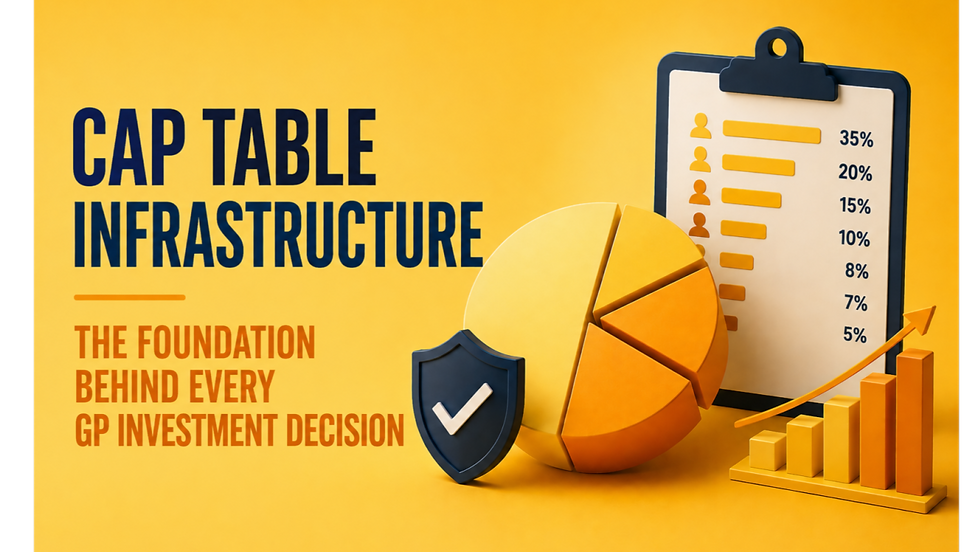
Most GPs don’t build cap tables.
But they rely on them — heavily.
Every key decision ultimately ties back to:
• ownership
• dilution
• waterfalls
• exit outcomes
• scenario analysis
And in many firms, all of that still sits in Excel.
Here’s the hidden risk:
Cap tables are often built and maintained by junior team members.
Smart, capable people — but:
• still learning complex preference structures
• interpreting dense legal docs
• building highly sensitive models under time pressure
Which means:
❌ Rights are misunderstood or simplified (participation, caps, SAFEs, conversions)
❌ Waterfalls get miss-calculated
❌ Logic becomes inconsistent across companies
Then they leave.
And suddenly:
• Where is the latest version?
• Which assumptions are correct?
• How does this waterfall actually work?
Even a well-built model becomes a black box.
And that’s before you consider Excel itself:
❌ Fragile waterfalls One error in a multi-round, multi-pref stack → incorrect distributions
❌ Slow scenario analysis Changing pre-money, prefs, or round structure = manual rebuilds
❌ Version chaos Founder files, legal docs, analyst versions — no single source of truth
❌ Hard to audit Tracing logic through layered formulas is time-consuming and uncertain
What changes with a purpose-built platform:
✅ Accurate, fast waterfalls Fully modeled preference stacks with reliable, defensible outputs
✅ Instant “what-if” analysis Change valuation, terms, or structure — see impact immediately
✅ Institutional knowledge (not personal) Logic, history, and data stay with the firm — not the individual
✅ Single source of truth Standardized, verified cap tables across the entire portfolio
✅ Governance & auditability Full traceability from legal docs → cap table → outputs
But the real shift — and what matters most to GPs:
Cap tables don’t just support deals.
They become the foundation of the firm’s investment infrastructure:
→ Portfolio management Accurate ownership tracking across companies and time
→ Fair value (ASC 820 / IPEV) Consistent, defensible inputs for valuation models and audits
→ LP reporting Clear, reliable data for performance, exposure, and outcomes
→ Exit analysis Confidence in distribution outcomes when it really matters
Bottom line
When cap tables live in Excel:
• accuracy depends on individuals
• knowledge walks out the door
• and critical decisions rely on fragile models
When they live in a structured platform:
• data is consistent
• logic is transparent
• and insights are instant
For GPs, that’s not just operational efficiency.
It’s better decisions, lower risk, and a stronger foundation for everything that follows.
That’s edge.


Comments